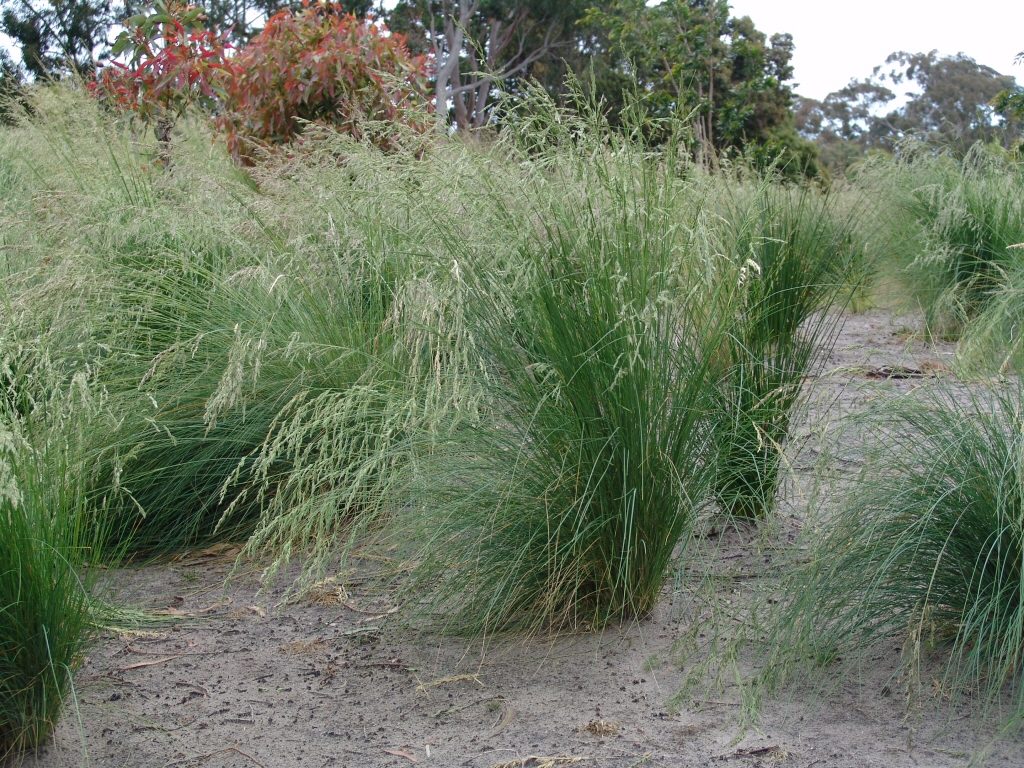
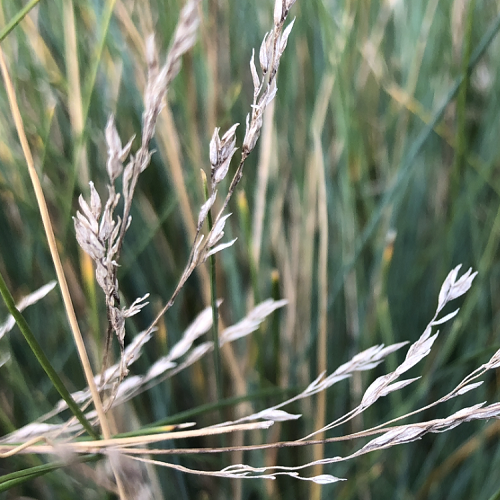
Tussock grasses or bunch grasses are a group of grass species in the family Poaceae. They usually grow as singular plants in clumps, tufts, hummocks, or bunches, rather than forming a sod or lawn, in meadows, grasslands, and prairies. As perennial plants, most species live more than one season. Tussock grasses are often found as forage in pastures and ornamental grasses in gardens.
Many species have long roots that may reach two meters (6 1⁄2 feet) or more into the soil, which can aid slope stabilization, erosion control, and soil porosity for precipitation absorption. Also, their roots can reach moisture more deeply than other grasses and annual plants during seasonal or climatic droughts. The plants provide habitat and food for insects (including Lepidoptera), birds, small animals and larger herbivores, and support beneficial soil mycorrhiza. The leaves supply material, such as for basket weaving, for indigenous peoples and contemporary artists.
Tussock and bunch grasses occur in almost any habitat where other grasses are found, including: grasslands, savannas and prairies, wetlands and estuaries, riparian zones, shrublands and scrublands, woodlands and forests, montane and alpine zones, tundra and dunes, and deserts.
Fire resistance
In western North American wildfires, bunch grasses tend to smolder and not ignite into flames, unlike invasive species of annual grasses that contribute to a fire's spreading.
Genera
- Examples:
Species
Australia
New Zealand
- Chionochloa australis – carpet grass
- Chionochloa flavescens – snow tussock
- Chionochloa oreophila – snow-patch grass
- Chionochloa rubra – red tussock
- Festuca novaezelandiae – fescue tussock or hard tussock
- Poa cita – silver tussock
- Poa colensoi – blue tussock
- Poa foliosa – muttonbird poa
North America
- Bunch grasses:
South America
- Deschampsia cespitosa – tufted hair-grass (up through North America)
- Nassella trichotoma – serrated tussock (common pasture weed in Australia)
- Poa flabellata – tussac grass (synonyms: Parodiochloa flabellata, Festuca flabellata, Dactylis caespitosa)
Africa
- Heteropogon contortus – perennial tussock grass (to Asia, Australasia, Oceania)
Europe
- Ampelodesmos mauritanicus – rope grass
- Brachypodium sylvaticum – false-brome
- Molinia caerulea – purple moor grass (to west Asia and north Africa)
See also
- List of Poaceae genera
- Tussock grassland
Non-Poaceae tussocks
- Carex appropinquata – fibrous tussock-sedge
- Carex stricta – tussock sedge
- Gahnia aspera – rough saw-sedge
References
External links
- California Native Grasslands Association: Bunchgrass species & habitats: preservation & restoration
- http://www.landcareresearch.co.nz/resources/identification/plants/grass-key Archived 2013-10-12 at the Wayback Machine