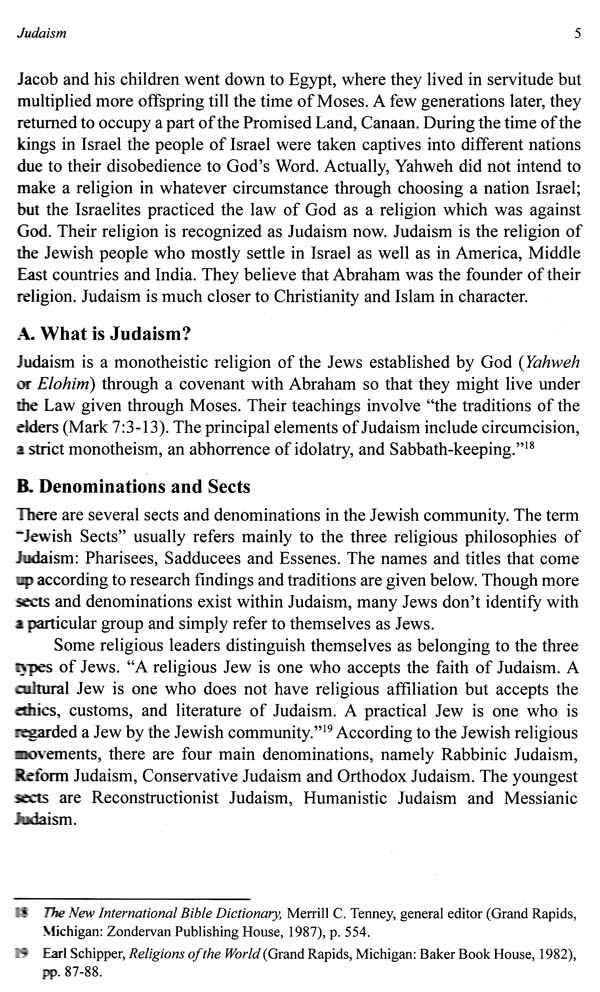
While the word religion is difficult to define and understand, one standard model of religion that is used in religious studies courses defines it as
[a] system of symbols which acts to establish powerful, pervasive, and long-lasting moods and motivations in men by formulating conceptions of a general order of existence and clothing these conceptions with such an aura of factuality that the moods and motivations seem uniquely realistic.
Many religions have their own narratives, symbols, traditions and sacred histories that are intended to give meaning to life or to explain the origin of life or the universe. They tend to derive morality, ethics, religious laws, or a preferred lifestyle from their ideas about the cosmos and human nature. According to some estimates, there are roughly 4,200 religions, churches, denominations, religious bodies, faith groups, tribes, cultures, movements, or ultimate concerns.
The word religion is sometimes used interchangeably with the words "faith" or "belief system", but religion differs from private belief in that it has a public aspect. Most religions have organized behaviours, including clerical hierarchies, a definition of what constitutes adherence or membership, congregations of laity, regular meetings or services for the purposes of veneration of a deity or for prayer, holy places (either natural or architectural) or religious texts. Certain religions also have a sacred language often used in liturgical services. The practice of a religion may also include sermons, commemoration of the activities of a God or gods, sacrifices, festivals, feasts, trance, rituals, liturgies, ceremonies, worship, initiations, funerals, marriages, meditation, invocation, mediumship, music, art, dance, public service, or other aspects of human culture. Religious beliefs have also been used to explain parapsychological phenomena such as out-of-body experiences, near-death experiences, and reincarnation, along with many other paranormal and supernatural experiences.
Some academics studying the subject have divided religions into three broad categories: world religions, a term which refers to transcultural, international faiths; Indigenous religions, which refers to smaller, culture-specific or nation-specific religious groups; and new religious movements, which refers to recently developed faiths. One modern academic theory of religion, social constructionism, says that religion is a modern concept that suggests all spiritual practice and worship follows a model similar to the Abrahamic religions as an orientation system that helps to interpret reality and define human beings, and thus believes that religion, as a concept, has been applied inappropriately to non-Western cultures that are not based upon such systems, or in which these systems are a substantially simpler construct.
Eastern religions
Abrahamic religions
Iranian religions
Indigenous (ethnic, folk) religions
Religions that consist of the traditional customs and beliefs of particular ethnic groups, refined and expanded upon for thousands of years, often lacking formal doctrine. Some adherents do not consider their ways to be "religion", preferring other cultural terms. Many indigenous religions incorporate forms of Animism, Totemism and Shamanism alongside Nature, Ancestor and Animal Worship
New religious movements
Religions that cannot be classed as either world religions or traditional folk religions, and are usually recent in their inception. Non-cargo cults are generally excluded from this list, see list of cults for cults
Historical religions
Other categorisations
By demographics
- Major religious groups
By area
- Religion in Africa
- Religion in Asia
- Religion in Oceania
- Religion in Europe
- Religion in North America
- Religion in South America
- Religions by country
- List of state-established religions
- Buddhism by country
- Buddhism in the United States
- Christianity by country
- Roman Catholicism by country
- Eastern Orthodoxy by country
- Oriental Orthodoxy by country
- Protestantism by country
- Hinduism by country
- Islam by country
- Ahmadiyya by country
- Judaism by country, Jewish population by country
- Sikhism by country
See also
- Alchemy
- Animal faith
- Civil religion
- Cult of personality
- Elite religion
- History of religion
- List of messiah claimants
- List of mythologies
- List of pantheons
- List of philosophies
- List of religious organizations
- List of religious populations
- List of schools of philosophy
- Lists of deities
- Lists of people by belief
- Magic
- Mythology
- Mysticism
- Religious fundamentalism
- Religious philosophy
- Secret Society
- State religion
- Witchcraft
References
Sources
- Clarke, Peter B., ed. (2006). Encyclopedia of New Religious Movements. London; New York: Routledge. ISBN 9-78-0-415-26707-6.
- Doniger, Wendy, ed. (2006). Britannica Encyclopedia of World Religions. Encyclopaedia Britannica. ISBN 978-1593392666.
- Eliade, Mircea, ed. (1987). The Encyclopedia of Religion. Vol. 16-volume Set. New York: MacMillan. ISBN 0029094801.
- Juergensmeyer, Mark; Roof, Wade Clark, eds. (2012). Encyclopedia of Global Religion. Vol. 1. Los Angeles, Ca: SAGE Publ. ISBN 978-0-7619-2729-7.
- Kitagawa, Joseph M., ed. (2002) [1987]. The Religious Traditions of Asia: Religion, History, and Culture. London: RoutledgeCurzon. ISBN 0-7007-1762-5.
- Lewis, James R., ed. (2004). The Oxford Handbook of New Religious Movements. New York: Oxford University Press. ISBN 0-19-514986-6.
- Lewis, James R.; Tøllefsen, Inga Bårdsen, eds. (2016) [2008]. The Oxford Handbook of New Religious Movements. Oxford Handbooks. Vol. 2 (2nd ed.). New York: Oxford University Press. ISBN 978-0-19-046617-6. Archived from the original on 2023-03-31.
- Melton, J. Gordon (2003) [1978]. Encyclopedia of American Religions (7th ed.). Farmington Hills, Mi: Gale Group. ISBN 978-0-7876-6384-1.
- Melton, J. Gordon; Baumann, Martin, eds. (2010). Religions of the world: a comprehensive encyclopedia of beliefs and practices. Vol. 1–6 (2nd ed.). Santa Barbara, Ca; Denver, Co; Oxford: ABC-Clio. ISBN 978-1-59884-203-6.
- Merriam-Webster's Encyclopedia of World Religions. Springfield, Ma: Merriam-Webster. 1999. ISBN 0-87779-044-2.
External links
- Maoz, Zeev; Henderson, Errol A. (2013). "The World Religion Dataset, 1945–2010: Logic, Estimates, and Trends". International Interactions. 39 (3): 265–291.
- Statistics on religious belief or adherence
- BBC.co.uk section on major world religions